Energy markets are complex, but the mechanism for how electricity gets priced is logical. At its core, the system performs a high-speed optimization, continuously matching supply and demand to serve load at the lowest possible cost while keeping the grid reliable.
One of the simplest ways to reason about that optimization is a merit order ranking. At Distill we use it as a first-pass lens for scenario analysis: quickly validating that results align with the expected supply stack and price formation. Since it is simple to iterate within a merit order dispatch curve, it is an easy way to build transparency into the primary features driving price movement across market footprints.
How the merit order works
Generators submit bids that describe:
- how much energy they can produce (MW)
- the price they are willing to accept ($/MWh)
The operator then:
- forecasts demand for a given interval
- accepts the lowest-cost bids first
- continues up the stack until demand is met
The last unit called, the marginal unit, sets the market clearing price (exact terminology varies across markets: marginal cost of energy, lambda, etc.). Every generator that clears is paid that same price, regardless of what they bid.
That single number is useful. It is also incomplete. Bid curves are deterministic: once a generator submits its bid schedule, it is fixed for that interval, but we cannot observe them ahead of time. The same is true of availability and demand. The honest way to reason about future market outcomes is to treat the unknowns probabilistically, even though each underlying input has a definite value when the market clears. Merit order is easier to teach as a static curve. Our goal is to present the result simply while keeping the full uncertainty visible. The Merit Order Explorer is how we do both.
Using the Merit Order Explorer
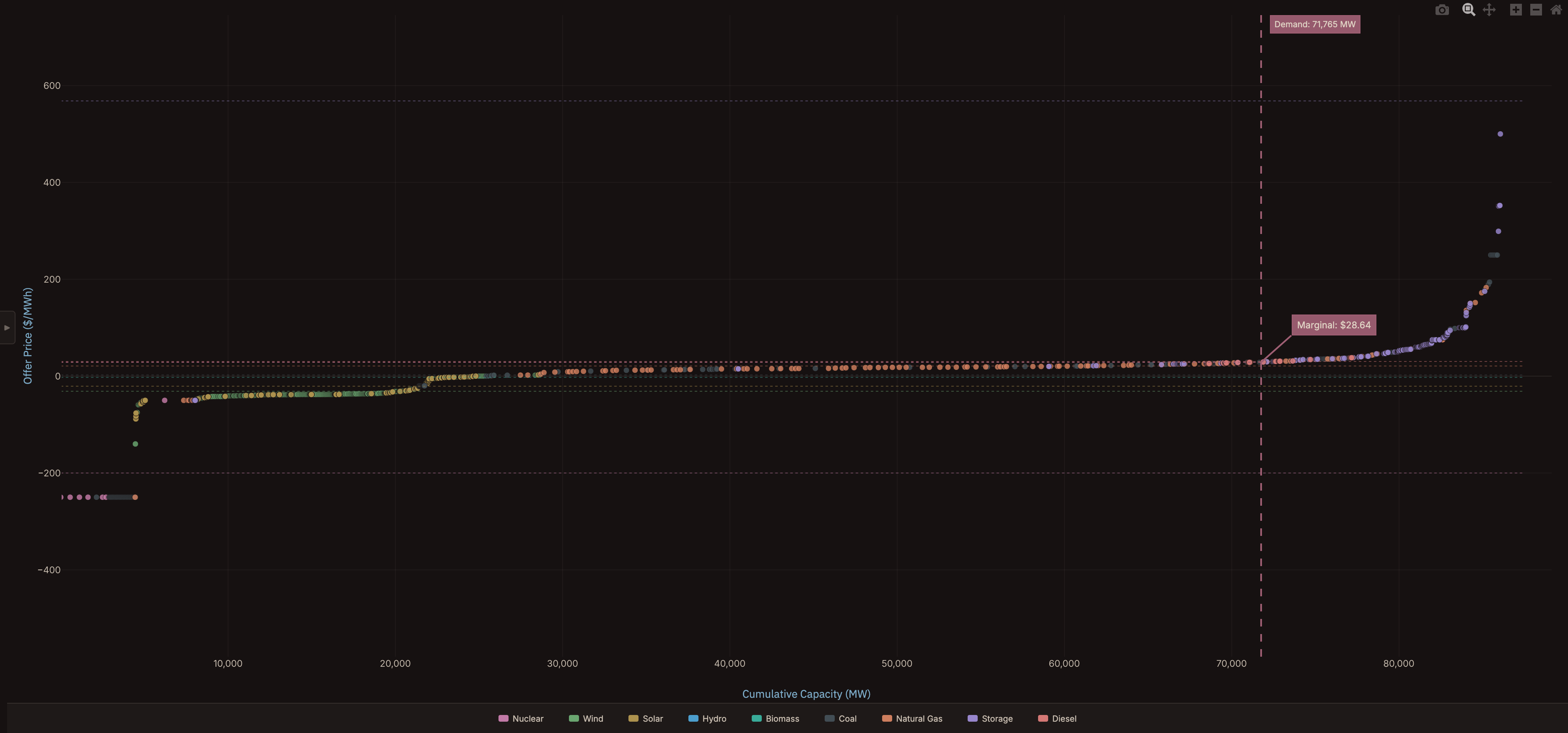
The Merit Order Explorer is built on ERCOT's 60-day SCED disclosure data, which publishes every generator's submitted offer curve. Each curve is a set of MW blocks and the price the generator is willing to accept for each block. The Merit Order Explorer sorts those offers across the entire fleet from cheapest to most expensive (that ranking is the merit order) and the height of each step is the price you would pay if demand stopped at that point on the curve. We also incorporate each unit's High Sustained Limit (HSL), the maximum sustained output it can produce, so the width of each step represents reported real available capacity rather than generic nameplate capacity.
- In the sidebar, choose the aggregation method that fits your question (Three-Part Offer (TPO) + SCED, TPO only, or SCED only; median or average bid price).
- Click any unit in the dispatch stack to see the distribution of bid curves by block and its
HSL distribution across hours of the day.
- For each unit and each bid block (e.g., the 1st MW block, the 2nd block,
etc.), the Explorer collects every offer the unit has submitted across
the historical SCED window (typically thousands of intervals per unit.)
We then summarize the distribution of prices at each block:
-
Median — the typical price the unit offered for that block
-
Interquartile range (P25–P75) — where half of the unit's historical offers fell
-
Min–Max — the full observed range

-
The chart stair-steps left to right by cumulative MW, with each step's height shown as a line at the median and shaded bands for the two ranges. This way you see both the unit's central tendency and how the price band it has historically operated within.
-
- Adjust bid prices by fuel type in the advanced settings if you want to stress-test a price scenario.
- For each unit and each bid block (e.g., the 1st MW block, the 2nd block,
etc.), the Explorer collects every offer the unit has submitted across
the historical SCED window (typically thousands of intervals per unit.)
We then summarize the distribution of prices at each block:
The Merit Order Explorer’s default view derates each fuel type's capacity using ERCOT's expected capacity contribution at the hour with the highest reserve shortage risk taken directly from the most recent MORA report. That default is a starting point, not a prescription: every slider in the advanced panel can be adjusted to match the scenario you actually want to run.
What merit order analysis gets right
Merit order is ideal when you need a quick, defensible answer. It assumes the grid uses the lowest-cost resources available in the moment. Price formation is simple: a single marginal unit sets the clearing price, and everyone else receives it.
When merit order analysis breaks down
Merit order is often taught as a single, static curve. In reality it is neither static nor deterministic. The grid is not a copper plate (where there are no losses, congestion and constraints) and electricity does not flow freely everywhere. Transmission constraints mean the cheapest generation cannot always reach the demand that needs it, and more expensive local units get dispatched instead. A merit order dispatch also misses important physical constraints of a power plant including ramp rates, start up costs and other items that impact the dispatch of power plants.
That is where point estimates start to mislead. The average clearing price across a day can look tame while the tail events, the hours where a single binding constraint pushes prices up, carry most of the actual financial risk. The Merit Order Explorer’s default view is a transparent first step: it shows the stack clearly, lets you adjust the inputs, and makes the assumptions visible. For the full decision-ready picture, you need to layer on the network physics, congestion, ramp rates and uncertainty that merit order alone cannot represent.
This is the problem Distill is built to solve.
Stay tuned - soon we’ll release demo versions of our full power flow. We also have labs planned to help distill market products like CRRs and key market inputs like capacity development into actionable insights. These are all components of our probabilistic power flow solution - reach out if you want to learn more.